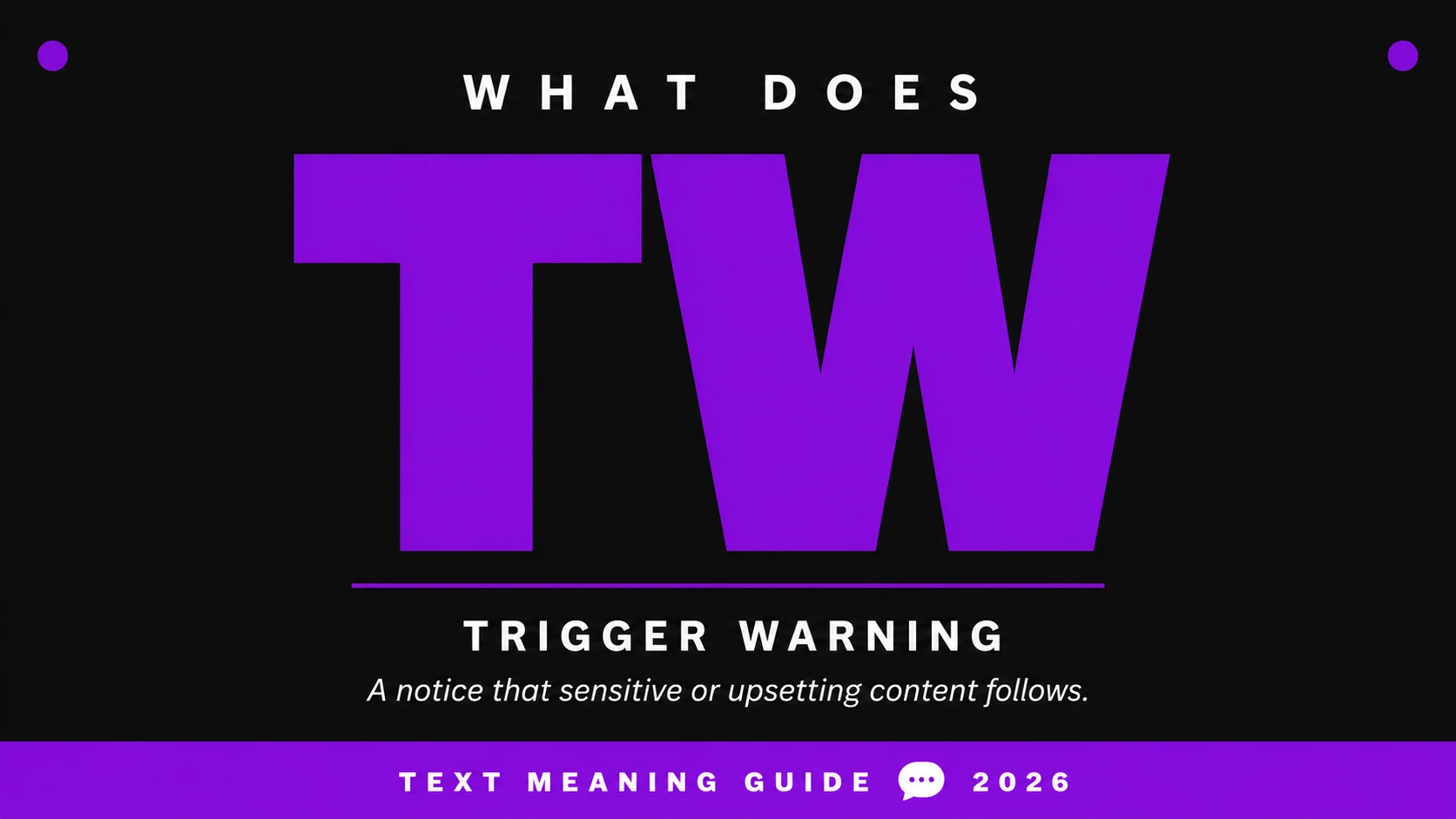
What does tw mean in text? Most often, TW means “trigger warning.” It gives you advance notice that a message, post, video, or conversation contains sensitive material. The warning lets you decide whether to continue, pause, or skip the content.
You will see TW before discussions involving violence, grief, abuse, eating disorders, mental health, medical trauma, or other emotionally difficult subjects. It can sound caring, serious, practical, or occasionally playful, depending on what follows and who sends it.
The Meaning Hiding Behind Those Two Letters
| What you see | What it usually means |
|---|---|
| tw | trigger warning |
| TW | trigger warning, with slightly more emphasis |
| tw grief | the following content discusses grief |
| tw food | the post may discuss food, dieting, or eating difficulties |
| tw violence | violent events or descriptions appear next |
| tw blood | blood, injuries, or medical details may be mentioned |
| tw anxiety | the content discusses anxiety or panic |
| tw abuse | abuse is discussed or referenced |
| tw spoilers | a playful variation warning you about story spoilers |
| tw jumpscare | a sudden visual or sound is coming |
TW is not usually part of the message’s main sentence. It works more like a label placed before the sensitive subject. When someone writes tw grief, they are not saying grief itself is happening at that moment. They are preparing you for what the next lines contain.
Capitalization rarely changes the definition. Lowercase tw feels casual and native to social media, while uppercase TW may look clearer or more deliberate. Both versions are widely understood in the same way.
Tw in Real Text Conversations
maya
tw pet loss i had to say goodbye to max today and i’m honestly wrecked
Context note Maya warns her friend before sharing upsetting news about a pet.
jordan
tw blood do not open the next pic if medical stuff makes you dizzy
Context note Jordan gives a specific warning before sending an injury photo.
lena
tw anxiety stuff can i vent about what happened during my presentation
Context note Lena checks whether her friend has space for a conversation about anxiety.
dev
tw spoilers for the finale okay but that ending made absolutely no sense
Context note Dev uses TW casually to protect someone who has not watched the episode.
nia
tw hospital talk my appointment went better than expected but the whole morning was rough
Context note Nia flags medical discussion without giving graphic details.
sam
tw food and calorie talk skipping this message is completely fine
Context note Sam names the subject and clearly gives readers permission to disengage.
eli
tw loud sound at 0:08 turn your volume down before you watch this 😭
Context note Eli pairs TW with a timestamp to make a video warning more useful.
zoe
tiny tw for secondhand embarrassment he started singing to me in the middle of the restaurant
Context note Zoe uses the expression jokingly for something uncomfortable rather than traumatic.
marcus
tw family drama my brother somehow turned brunch into a three-hour argument
Context note Marcus signals that a personal story may involve conflict or emotional stress.
ava
tw death mention nothing graphic but i wanted to give you a heads-up *Context note* Ava explains the intensity so the warning does not feel vague or alarming.
Where You Are Most Likely to See Tw
| Digital space | How TW commonly appears there |
|---|---|
| TikTok | in captions, opening text, slides, or spoken introductions |
| before a caption, Story sequence, Reel, or sensitive image | |
| in post titles, flair, body text, or comments | |
| Tumblr | in tags and opening lines before personal or fandom posts |
| Discord | before vent messages, images, links, or community discussions |
| Group chats | before personal news, photos, or emotionally heavy updates |
| YouTube | in video descriptions, opening screens, chapters, or pinned comments |
| X | at the start of posts or threads discussing sensitive subjects |
| before personal stories, community posts, or shared articles | |
| Text messages | before a serious confession, image, video, or difficult conversation |
The format changes with the platform. On a short-form video, the warning may appear on screen for a few seconds. On Reddit or Tumblr, people may place it in a title or tag so you see it before opening the full post.
In private messages, TW often doubles as a gentle check-in. A friend may write tw family stuff before venting, which gives you a moment to decide whether you are ready to respond thoughtfully.
What Does Tw Mean in Text When the Tone Changes?
Serious and protective
riley tw discussion of self-harm no graphic details but please take care before reading
Context note The warning is direct because the subject could be intensely distressing.
Gentle and considerate
imani tw pregnancy talk totally okay to mute this chat for a bit 💛
Context note The sender acknowledges that a normally happy topic can still be difficult for someone.
Practical and neutral
owen tw flashing lights from 12 seconds onward
Context note The warning provides useful viewing information without adding emotion.
Casually supportive
kate tw work stress i need to complain for like two minutes lol
Context note The topic is serious enough to flag, but the friendship keeps the wording relaxed.
Playfully dramatic
noah tw horrible haircut my barber has declared war on me
Context note TW is being exaggerated for comedy rather than used for genuine traumatic material.
Fandom focused
cass tw character death and finale spoilers
Context note The warning covers both emotional content and plot information.
Cautious but vague
leo tw heavy topic
Context note The sender means well, but the warning would be more helpful if the subject were named.
Invitation to consent
dani tw breakup stuff are you okay if i vent for a sec
Context note Dani uses TW and asks permission before starting an emotional conversation.
Reassuring
chris tw accident mention but everyone is safe
Context note The warning prepares the reader while immediately reducing unnecessary worry.
Community minded
**moderator** tw racism and harassment in the screenshots below *Context note* A moderator labels harmful material while documenting a community issue.
Useful Tw Formats You Can Copy
| Situation | Natural wording |
|---|---|
| A subject is mentioned briefly | tw brief mention of grief |
| Details are included | tw detailed discussion of surgery |
| An image may be upsetting | tw injury photo in the next message |
| A clip contains loud audio | tw loud noise around 15 seconds |
| A video flashes rapidly | tw flashing lights near the end |
| You want to vent privately | tw family conflict can i vent |
| A topic is not graphic | tw abuse mention nothing graphic |
| Several topics appear | tw grief anxiety and hospital talk |
| A fictional event is discussed | tw spoilers and character death |
| The warning applies later | tw for slide 6 onward |
A useful TW usually names the subject instead of only saying tw. Readers cannot make an informed choice when they do not know what the warning covers. Something like tw medical details gives far more information than a floating pair of letters.
You can also mention the intensity, location, or timing. Phrases such as brief mention, graphic description, next image, and around 20 seconds help people navigate the content without guessing.
Emoji Pairings That Shape the Mood
tw grief 🕊️
The dove creates a quiet, memorial tone and often appears with loss-related posts.
tw pet loss 🐾
Paw prints gently signal that the message concerns an animal companion.
tw anxiety 🫂
The hugging emoji adds warmth and makes the warning feel supportive.
tw medical talk 🏥
The hospital emoji quickly clarifies the category of sensitive content.
tw blood 🩸
This pairing is visually clear, though it may feel too graphic for some readers.
tw loud noise 🔊
The speaker emoji makes an audio warning easy to notice before playing a clip.
tw flashing lights ⚠️
The warning symbol emphasizes that the notice involves physical viewing safety.
tw heavy topic 💛
A yellow heart softens the message without making the subject seem trivial.
tw spoilers 👀
The eyes emoji gives spoiler warnings a curious, teasing tone.
tw cringe 😭
The crying emoji usually signals humorous exaggeration rather than a formal warning.Emoji do not replace the topic label.
tw ⚠️still leaves your reader wondering what is coming. A clear phrase with an optional emoji works better, especially when the subject is serious.For genuinely sensitive material, simple pairings usually feel most respectful. A swarm of dramatic emojis can accidentally make the warning look like a joke or draw more attention to the content than intended.
Tw Beside Its Internet Cousins
| Abbreviation | How it differs from TW |
|---|---|
| CW | content warning, often used as a broader label for potentially uncomfortable material |
| CN | content note, a softer alternative used before sensitive or notable subjects |
| NSFW | warns that material may be inappropriate for work or public viewing |
| NSFL | warns of extremely disturbing material that may be hard to view |
| TMI | means too much information, usually reacting to oversharing |
| PSA | public service announcement, used to highlight useful information |
| FYI | for your information, a neutral heads-up without a sensitivity warning |
| SA | can mean sexual assault in warning labels, though context is essential |
| ED | may mean eating disorder in sensitive-content discussions |
| MH | mental health, often included as the topic after TW or CW |
TW and CW frequently overlap, and plenty of people use them interchangeably. Some users reserve TW for content that may provoke a trauma-related response and use CW for broader subjects such as insects, food, needles, spoilers, or loud sounds.
NSFW serves a different purpose. It usually describes sexual, graphic, or workplace-inappropriate material rather than focusing on a reader’s emotional response. A post can reasonably carry both labels when both concerns apply.
How Tw Grew from Community Language
| Stage | How the usage developed |
|---|---|
| Trauma discussions | The word trigger described stimuli connected with intense trauma responses |
| Survivor communities | Online groups began warning readers before graphic personal accounts |
| Feminist blogs | Trigger warnings became common before discussions of assault and violence |
| Tumblr tagging | Users added TW labels and topic tags to help followers filter posts |
| Forum culture | Communities adopted warnings for long stories, images, and discussions |
| Social platforms | TW spread into captions, videos, threads, and comment sections |
| Private messaging | Friends began using it before venting or sending sensitive material |
| Broader categories | Warnings expanded to grief, food, medical issues, and flashing visuals |
| Humorous usage | People started using TW dramatically for cringe, spoilers, and minor annoyances |
| Current usage | TW now ranges from serious safety label to casual internet shorthand |
The modern online form grew through community moderation and user-created posting habits rather than one universal rulebook. Early usage was especially visible in survivor-focused spaces, feminist blogs, Tumblr communities, and discussion forums.
As TW moved into mainstream social media, its meaning widened. You may now see it before anything from a detailed account of violence to a clip containing a loud jumpscare. Context tells you whether the warning is clinical, considerate, casual, or comedic.
Small Details That Make a Tw More Helpful
Name the actual subject
you tw grief and funeral talk
Context note A clear label lets readers decide based on the topic itself.
Place it before the content
you tw blood in the photo below
Context note A warning loses its purpose when it appears after the upsetting material.
Mention whether details are graphic
you tw car accident mention nothing graphic
Context note This prevents readers from imagining something more intense than the actual message.
Add a timestamp for video
you tw loud scream at 0:24
Context note A timestamp helps viewers mute or skip the exact moment.
Separate the warning visually
you
tw hospital details
update from today’s appointment
Context note A blank line gives the reader a natural stopping point.
Use familiar words
you tw discussion of panic attacks
Context note Clear language works better than obscure abbreviations stacked together.
Avoid revealing unnecessary details
you tw major finale spoiler
Context note You can identify the category without spoiling the plot inside the warning.
Give permission to skip
you tw pregnancy talk feel free to skip this one
Context note This can make a warning feel caring instead of ceremonial.
Check before venting directly
you tw family drama do you have space for a vent
Context note The other person gets a genuine chance to say not right now.
Match the warning to the content
**you** tw graphic dental procedure photos *Context note* Specific wording prepares the reader more accurately than `tw medical`.
Is Tw Always Serious?
TW began as a practical warning for material that could cause severe distress, so its serious use still matters. When it appears before topics such as assault, self-harm, abuse, or graphic violence, you should read it as a genuine heads-up.
Internet humor has also turned TW into playful exaggeration. Someone might write tw embarrassing dancing before posting a goofy video. The joke works because the person treats harmless awkwardness as though it requires an official warning.
The surrounding language usually makes the tone obvious. Specific subjects, careful wording, and phrases like graphic details suggest sincerity. Dramatic complaints, laughing emojis, and absurdly minor topics point toward humor.
Even in playful posts, TW still performs the same basic job. It previews what comes next. The difference is that the warned-about content is mildly uncomfortable, silly, or spoiler-heavy rather than deeply distressing.
When Tw Could Mean Something Else
Trigger warning is the safest interpretation when TW appears immediately before a topic, caption, video, or personal story. However, abbreviations depend heavily on location and sentence structure.
In older posts, tech conversations, or social media analytics, tw may refer to Twitter, the platform now called X. A phrase such as saw it on tw is more likely talking about the platform than warning you about content.
In gaming, work, school, and niche communities, TW can represent names, titles, locations, or technical terms. A World of Warcraft player, for example, may use it for Time Warp. Those meanings are community-specific rather than general texting slang.
Look at the words beside it. tw blood clearly signals a trigger warning. posted it on tw probably refers to Twitter. use tw before the boss could belong to a game. Position and topic solve most of the mystery.
How to Respond When Someone Uses Tw
You do not need a special scripted response. You can read the label, decide whether you are comfortable continuing, and react to the actual message when you are ready.
In a private chat, you might say yeah i have space to listen or can we talk about this later. Both are normal responses. TW gives you information, not an obligation to engage immediately.
When a friend warns you before venting, acknowledge the subject without turning the conversation into a debate about wording. A simple thanks for checking first keeps the exchange warm and human.
You can also ask for clarification when the label is vague. what’s the tw for is reasonable when someone sends only tw and nothing else. A useful warning should tell you what kind of material follows.
Why Tw and Cw Often Get Mixed Up
TW means trigger warning, while CW means content warning. In everyday online use, both introduce material that someone may prefer not to encounter unexpectedly.
Some communities treat CW as the broader label. They may use it for blood, insects, dieting, pregnancy, flashing images, spoilers, or body-related discussion, while reserving TW for subjects closely associated with trauma.
Other communities make no distinction at all. Their members choose whichever abbreviation is familiar, expected by moderators, or easier to search and filter.
You do not need to police the difference in casual texting. Clarity matters more than choosing the theoretically perfect abbreviation. cw food discussion and tw food discussion both communicate more than an unexplained warning.
Faqs About Tw in Texting
Common Questions from Real Chats
What does TW mean in a text message?
TW usually means trigger warning, a notice that sensitive or upsetting content follows.
Is TW the same as a content warning?
They overlap, though CW is often broader while TW is more closely associated with trauma-related subjects.
Can TW mean Twitter?
Yes, especially in phrases such as i saw it on tw, but it usually means trigger warning before a sensitive topic.
Why do people write TW before spoilers?
They are using the warning format casually to help others avoid unwanted plot information.
Should you respond when someone sends a TW?
You can continue, ask for more context, or say you are not ready to discuss the subject.