
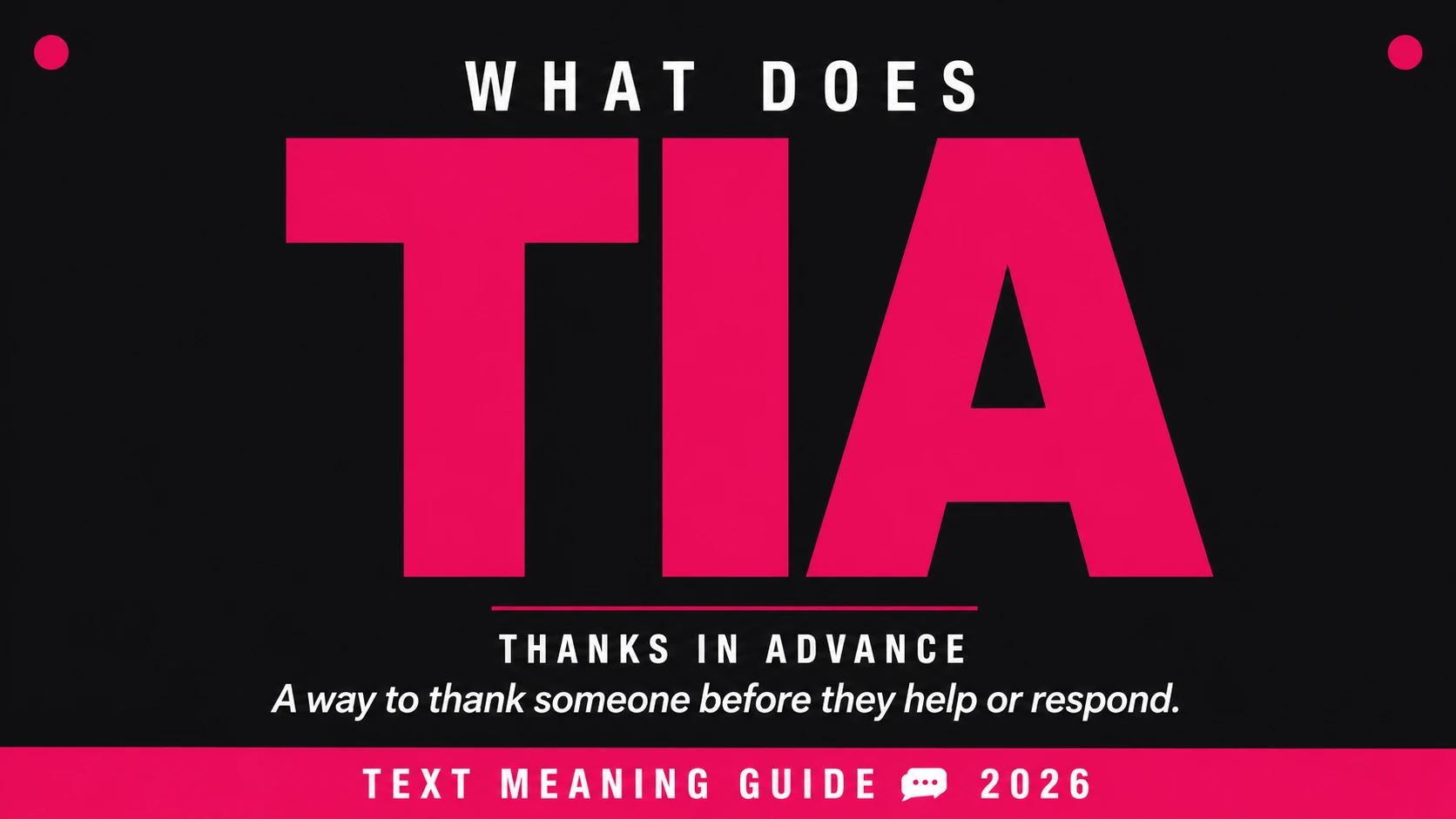
Wondering what does TIA mean in text after spotting it beneath a question, favor, or slightly ambitious request? In most chats, TIA means thanks in advance. It is a compact way to appreciate someone before they answer, share information, or complete the thing being requested.
You will see TIA in texts, emails, group chats, forums, social posts, and community pages. It can sound friendly and efficient, but tone matters. From a close friend, it feels casual. From a demanding coworker, it can feel like your agreement has already been assumed.
The Tia Meaning in Text at a Glance
| Texting detail | What it tells you |
|---|---|
| Full form | TIA stands for thanks in advance |
| Basic purpose | It expresses appreciation before someone helps or responds |
| Most common position | At the end of a question, request, or favor |
| Typical tone | Polite, casual, practical, and slightly expectant |
| Common platforms | Text messages, email, Reddit, Facebook groups, forums, Slack, and community chats |
| Capitalization | TIA and tia mean the same thing in casual conversation |
| Punctuation style | TIA! feels upbeat, while TIA. may feel more formal or firm |
| Best audience | Friends, classmates, coworkers, neighbors, and online communities |
| Main tone risk | It can sound presumptuous when the request is large or difficult |
| Medical exception | In health-related writing, TIA may mean transient ischemic attack, not thanks in advance |
Tia in Real Text Conversations
Maya
can you send me the address again tia
Context note Maya is making a small, easy request and thanking the recipient before they reply.
Chris
anyone know what time the gym closes tonight tia
Context note Chris is asking a group for quick information rather than directing the request at one person.
Nina
pls save me a seat near the front tia 🙏
Context note The prayer hands soften the request and make the advance thanks feel warmer.
Jordan
can somebody cover my shift friday tia
Context note This is a bigger favor, so TIA may sound optimistic or slightly presumptuous without more context.
Alex
drop your best taco spots in san diego tia
Context note Alex is inviting recommendations, which is one of the most natural uses of TIA online.
Sam
does anyone have the notes from yesterday tia!!
Context note The double exclamation marks add urgency and friendly energy.
Taylor
can you review the deck before lunch tia
Context note In a workplace chat, this may sound efficient, but it can also imply that Taylor expects the task to be accepted.
Riley
need gift ideas for a 10 year old who loves science tia 😊
Context note The smiling emoji makes the request feel open, grateful, and conversational.
Morgan
lmk if this bus stops downtown tia
Context note TIA works with other abbreviations and keeps the message brief without changing its meaning.
Drew
send pics when you get there tia lol
Context note The word lol makes the request playful and reduces the potentially bossy edge.
Where You Are Most Likely to See Tia
| Platform or setting | How TIA usually appears there |
|---|---|
| Personal texts | Attached to quick favors such as sending a photo, address, link, or reminder |
| Group chats | Used when anyone in the group can answer a question |
| Facebook groups | Common after requests for local recommendations, services, advice, or lost-item help |
| Often added to advice questions or requests for firsthand experience | |
| Used after asking for information, documents, confirmation, or action | |
| Slack and Teams | Appears in short workplace requests, especially when speed matters |
| Gaming chats | Used when asking for instructions, item locations, builds, or troubleshooting help |
| Marketplace messages | Added to questions about availability, measurements, pickup, or condition |
| School communities | Common in requests for notes, deadlines, schedules, or assignment details |
| Neighborhood forums | Used for contractor suggestions, local updates, pet sightings, and community information |
TIA has long been categorized as online shorthand used across texting, chat, email, blogs, and discussion groups.
How Tiny Changes Shift the Tone
tia
can you send the link tia
Context note Lowercase tia feels relaxed, quick, and natural between people who already know each other.
TIA
please confirm the final count TIA
Context note Capital letters are standard for an initialism, but they can look more formal in an otherwise casual message.
tia!
share your playlist recs tia!
Context note The exclamation point makes the advance thanks sound cheerful rather than demanding.
tia!!
someone tell me how to fix this tia!!
Context note Extra punctuation adds urgency, excitement, or mild panic.
tia 🙂
can you grab me a coffee too tia 🙂
Context note The smile signals friendliness and helps the request feel less transactional.
tia lol
remind me not to text him again tia lol
Context note Lol turns the message into a joke and shows that the request is not overly serious.
TIA.
send the completed form by five TIA.
Context note A final period can make the message feel firm, managerial, or passive-aggressive.
thanks in advance
could you check the total for me thanks in advance
Context note Writing out the phrase sounds more deliberate and is often safer in professional communication.
thanks so much in advance
would you mind feeding the cat this weekend thanks so much in advance
Context note The extra gratitude fits a favor that takes more time or effort.
no TIA at all
could you help me move saturday
Context note A direct question leaves clearer room for the other person to accept or decline.
Emoji Pairings That Work Naturally with Tia
| Pairing | Tone it adds |
|---|---|
| tia 🙏 | Hopeful, grateful, or gently pleading |
| tia 😊 | Warm, friendly, and approachable |
| tia 🙂 | Polite and mild, though it can feel restrained in tense conversations |
| tia ❤️ | Affectionate, best for friends, family, or supportive communities |
| tia 😂 | Playful, especially when the request is funny or slightly ridiculous |
| tia 😭 | Dramatic urgency, usually exaggerated for humor |
| tia 🤞 | Hopeful when asking for answers, availability, or good news |
| tia ✨ | Enthusiastic, cute, or intentionally upbeat |
| tia 🫶 | Extra appreciation and emotional warmth |
| tia 😅 | Slight embarrassment when asking for a favor or admitting confusion |
Emoji pairings are not part of TIA’s formal definition. They work as tone signals, helping your reader decide whether the request is sincere, playful, urgent, affectionate, or awkward.
Similar Abbreviations You Might See Nearby
TY
ty for sending that
Context note TY means thank you and is normally used after someone has already helped.
TYSM
tysm you saved me
Context note TYSM means thank you so much and carries more enthusiasm than TIA.
TYIA
can you check the file tyia
Context note TYIA means thank you in advance and communicates almost exactly the same idea as TIA.
THX
thx for the heads up
Context note THX is a casual spelling of thanks and usually responds to something already done.
PLS
pls send the code
Context note PLS means please and softens the request without pre-thanking the recipient.
LMK
lmk what time works
Context note LMK means let me know and often appears in the same message as TIA.
FYI
fyi the meeting moved
Context note FYI means for your information and shares information rather than requesting help.
TIAFAYH
can you help me reset this tiafayh
Context note TIAFAYH means thanks in advance for all your help, but it is far less common and looks noticeably more old-school.
YW
yw anytime
Context note YW means you’re welcome and may be used after someone thanks you.
NP
np i got you
Context note NP means no problem and is a natural response after agreeing to a TIA request.
When Tia Does Not Mean Thanks in Advance
| Context clue | Likely meaning |
|---|---|
| A casual request for help | Thanks in advance |
| A question in a local group | Thanks in advance |
| An email asking for a document | Thanks in advance |
| A medical conversation | Transient ischemic attack |
| Stroke symptoms or neurological care | Transient ischemic attack |
| A person’s name is capitalized as Tia | The name Tia, not an abbreviation |
| Spanish family conversation | Tía may mean aunt, usually written with an accent |
| An industry or organization document | It may represent a specialized organization or technical term |
| A caption about African life or travel | Occasionally interpreted as this is Africa |
| A sentence with no request or gratitude | Use the surrounding topic to identify another meaning |
Context does most of the work. Cambridge Dictionary lists both the internet abbreviation for thanks in advance and the medical abbreviation, while medical organizations use TIA for a temporary interruption of blood flow to the brain.
Natural Ways to Reply When Someone Says Tia
Jamie
can you send the receipt tia
You
yep sending it now
Context note A direct confirmation is usually more natural than replying with you’re welcome.
Casey
any chance you can pick me up tia
You
sure what time
Context note You accept the favor while asking for the missing detail.
Lee
cover my shift tomorrow tia
You
sorry i can’t tomorrow
Context note TIA does not obligate you to say yes, so a polite decline is completely valid.
Avery
check whether the store has my size tia
You
got you
Context note Got you is brief, casual, and reassuring.
Quinn
can someone explain question four tia
You
yeah it’s asking you to compare both examples
Context note In a group, you can simply provide the requested answer.
Parker
send me your login tia
You
i can’t share my login but i can send the file
Context note You can set a boundary and offer a safer alternative without arguing about the wording.
Reese
need restaurant ideas near the theater tia 😊
You
try luna cafe it’s like two blocks away
Context note Recommendation requests invite a specific, useful response.
Cameron
can you finish my part too tia
You
i can help you review it but i can’t finish the whole section
Context note A clear limit works well when the request is larger than expected.
Blake
remind me at six tia
You
yep i’ll text you
Context note Mirroring the sender’s casual style keeps the exchange comfortable.
Devon
can you resend the invite tia
You
just resent it
Context note Once the task is complete, a simple status update is enough.
Why People Put Tia at the End of a Request
TIA saves space, but the abbreviation is doing more than trimming a few letters. It signals that you expect someone may spend time answering your question or completing a favor, and you want to acknowledge that effort upfront.
It is especially useful in public posts where you cannot thank every future commenter individually. A closing like “drop your best budget laptop recs tia” tells the group that suggestions are welcome and appreciated.
TIA also creates a small sense of expectation. By thanking someone before they agree, you may unintentionally make the request sound settled. That is why the same three letters can feel sweet in one conversation and pushy in another.
The difference usually depends on the relationship, request size, and wording around it. “can you send that pic tia” is light. “rewrite the whole report tonight TIA” sounds like an assignment disguised as gratitude.
How to Use Tia without Sounding Bossy
Give the other person room to choose. Phrases such as “could you,” “any chance,” and “when you get a minute” make TIA feel like appreciation instead of pressure.
You can write “any chance you can send the notes when you’re free tia 😊” rather than “send the notes tia.” Both communicate the same task, but only one clearly respects the recipient’s time.
Match TIA to the size of the favor. It works beautifully for links, recommendations, directions, photos, and quick answers. For airport rides, weekend pet care, or several hours of work, a fuller thank-you usually feels more sincere.
You might say “would you be able to watch luna saturday night? totally okay if not, and thank you for considering it.” TIA is not wrong there, but three letters may feel too breezy for a meaningful commitment.
What Does Tia Mean in Text from Different People?
From a friend, TIA usually reads like playful shorthand. Your friend may assume you understand their tone, especially if the request includes “pls,” “lol,” an emoji, or an inside joke.
From a stranger in a community group, it is usually a polite closing. The sender is asking the crowd for advice and thanking whoever decides to contribute.
From a coworker, the meaning is still thanks in advance, but hierarchy matters. A manager’s “please complete this today TIA” can sound less like gratitude and more like an instruction.
From someone you barely know, read the full message before judging. Some people use TIA automatically, while others avoid it because advance thanks can feel presumptive. Online discussions show that people genuinely disagree about whether the phrase sounds courteous or irritating.
Tia Etiquette for Work, School, and Group Chats
In casual school chats, TIA fits requests for notes, deadlines, room numbers, and study resources. Keep the message specific so your classmates know exactly what you need.
At work, spelling out “thanks in advance” can feel more polished, but it does not automatically fix a demanding request. A clear deadline, realistic workload, and genuine option to discuss timing matter more than the abbreviation.
In neighborhood or interest groups, TIA is extremely practical. It works well after questions about plumbers, restaurants, parking, recipes, travel tips, tech problems, and product recommendations.
Avoid adding it to sensitive announcements, emotional conversations, or requests that need careful consent. When the situation deserves nuance, writing a complete sentence will sound more thoughtful than dropping an acronym at the end.
Frequently Asked Questions About Tia
What does TIA mean in text messages?
TIA usually means thanks in advance, especially when it follows a question or request.
Is TIA polite or rude?
It is usually polite, but it may sound pushy when the sender assumes you will complete a large favor.
Can I use TIA in a professional email?
Yes, though writing “thank you in advance” or thanking the person for their time often sounds more polished.
What is the difference between TIA and TY?
TIA thanks someone before they help, while TY usually thanks them after they have already done something.
Does TIA always mean thanks in advance?
No, medical conversations commonly use TIA to mean transient ischemic attack, so always check the context.